More Than Just Words: Defining the Core Functions
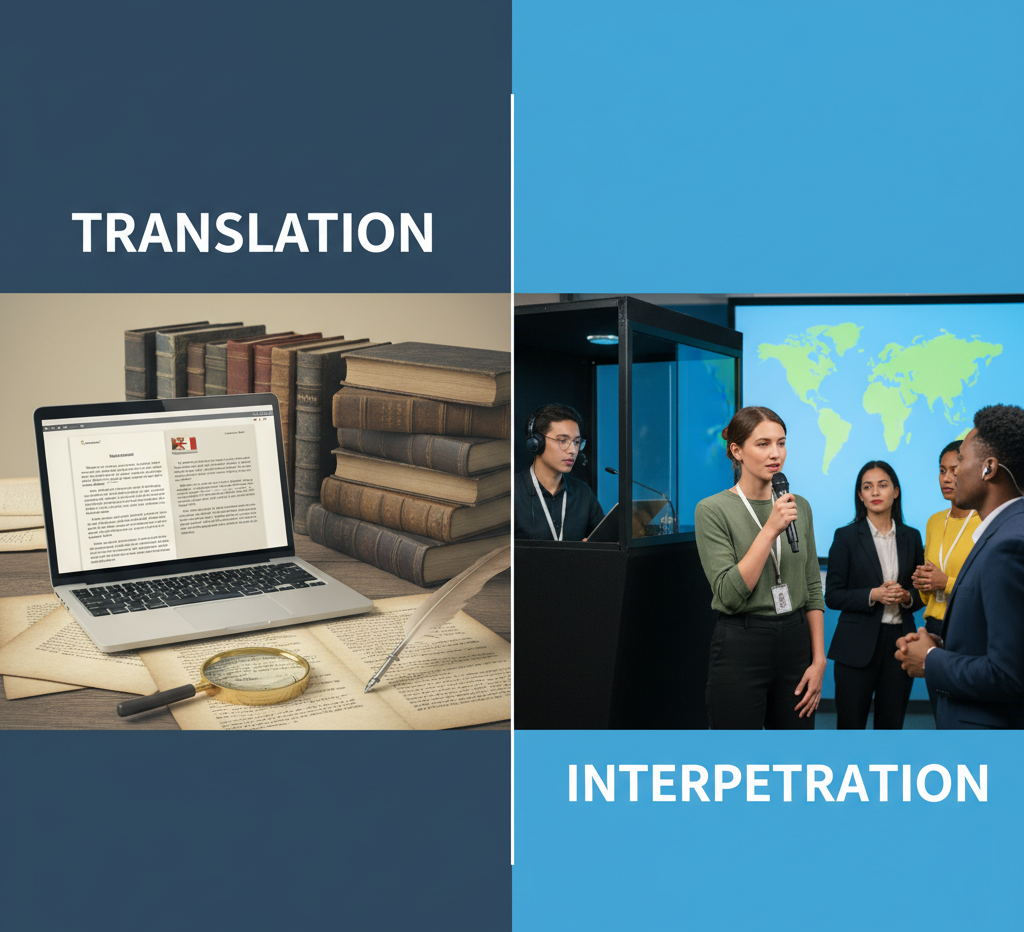
Many people use the words “translation” and “interpretation” as if they are interchangeable. It’s a common assumption that if you’re good at one, you’re automatically good at the other. In reality, while they share the fundamental goal of bridging communication gaps across languages, they are distinct disciplines requiring different skill sets, processes, and even cognitive functions. The simplest way to remember the difference is this: translators work with the written word, while interpreters work with the spoken word.
Think of it like the difference between a novelist and a stand-up comedian. Both are masters of language, but they operate in completely different arenas. A novelist has the luxury of time—to revise, to refine, to find the perfect turn of phrase. A stand-up comedian must be spontaneous, reading the room and delivering punchlines with impeccable timing. Similarly, a translator meticulously crafts a text, consulting dictionaries and style guides, while an interpreter must think on their feet, conveying meaning, tone, and intent in real-time. This fundamental distinction in medium—written versus spoken—ripples out to affect every other aspect of the work.
The Translator’s World: Precision and Permanence
A translator’s primary mission is to produce a written text in a target language (the language being translated into) that accurately conveys the meaning, style, and tone of the source text (the original language). This process is inherently slow and deliberate. It allows for, and in fact demands, research, revision, and collaboration.
The types of materials a translator works with are vast and varied. This includes:
- Literary Works: Novels, poems, and short stories, where capturing the author’s unique voice is as important as translating the plot.
- Legal Documents: Contracts, patents, and court rulings, where absolute precision is non-negotiable and a single mistranslation can have serious consequences.
- Technical Manuals: Instructions for machinery, software, or medical devices, requiring not only linguistic skill but also subject-matter expertise.
- Marketing and Website Content: Here, the translator often becomes a “transcreator,” adapting slogans and concepts to resonate with a new culture.
A key tool in the modern translator’s arsenal is Computer-Assisted Translation (CAT) software. Unlike machine translation, which automatically translates text, CAT tools help human translators work more efficiently by storing previous translations in a “translation memory” and providing easy access to terminology databases. This ensures consistency across large projects, like translating a whole website or a series of technical documents for a single client. The final product of a translator’s work is a permanent, polished document that can be reviewed, edited, and published.
The Interpreter’s Arena: Speed and Presence
An interpreter’s world is one of immediacy. Their core function is to listen to a speaker in one language and almost simultaneously reproduce the message in another language, preserving its full meaning, nuance, and emotional intent. This requires an extraordinary ability to concentrate, process information quickly, and speak eloquently under pressure.
There are different modes of interpretation, each suited to specific situations:
- Simultaneous Interpretation: The interpreter works in real-time, often from a soundproof booth, listening through headphones and speaking into a microphone while the original speaker continues. This is the standard for large, multilingual conferences, United Nations meetings, and live television broadcasts. It is mentally exhausting, requiring intense focus, and interpreters typically work in pairs, switching off every 20-30 minutes.
- Consecutive Interpretation: Here, the speaker says a few sentences or a paragraph and then pauses while the interpreter renders the message into the target language. The interpreter often uses a specialized system of note-taking to remember the key points of a longer speech. This is common for business meetings, legal depositions, and medical appointments.
- Whispered Interpretation (Chuchotage): A form of simultaneous interpretation where the interpreter sits or stands next to one or two listeners and softly whispers the translation into the target language. This is used in small meetings where only a few participants need interpretation.
The interpreter’s “product” is ephemeral—it exists in the moment and is gone. There is no backspace key, no second draft. Their success is measured by the smoothness and accuracy of the communication in that live, unedited setting.
The Common Ground: The Bridge Builder’s Core Skills
Despite their differences, elite translators and interpreters share a common foundation of essential skills. First and foremost is near-perfect bilingualism. However, this goes far beyond simply knowing two languages. It involves a deep, intuitive understanding of the cultures behind the languages—the idioms, the historical references, the social taboos, and the unspoken assumptions that give language its true meaning.
Both professions require exceptional listening and analytical skills. A translator must read between the lines of a text to understand the author’s intent, while an interpreter must decode a speaker’s message beyond the literal words. Furthermore, outstanding writing skills are crucial for the translator, while crystal-clear public speaking skills are a must for the interpreter. In both cases, a rigorous ethical code of confidentiality, impartiality, and professionalism is the bedrock of the practice.
In conclusion, while translation and interpretation are two sides of the same coin, they are different currencies. One deals with the permanence of text, the other with the fluidity of speech. Understanding this distinction is the first step in appreciating the skill and expertise required by both these vital professions, which work silently and efficiently to make our world a little smaller and a great deal more understandable.


Leave a Reply